Rapid prototyping: A.Piovan’s solution for technical components

Enrico Zanini
When a customer requires a specific polyurethane castingcompound, producinga mould involves significant investment and weeks of work: a process that makes sense when the geometry has already been validated and the production volumes are substantial, but which becomes a risk when the project is still in the development phase or production volumes are low.
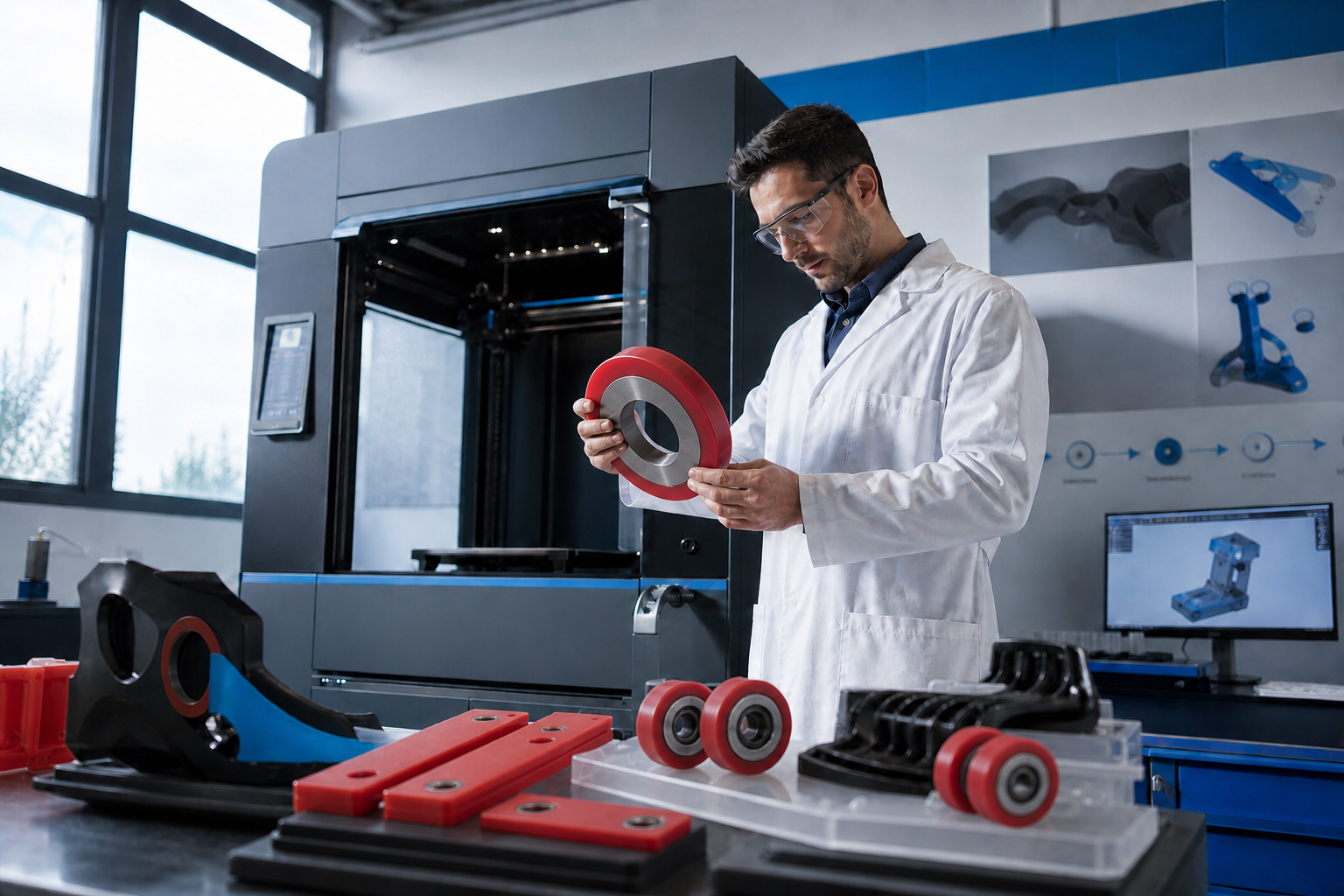
This is where 3D printing applied to mould prototyping changes the game, enabling a more dynamic and astute approach that is well suited to today’s market demands. Thanks to 3D printing, A.Piovan is able to produce prototype moulds much more quickly than with traditional methods, whilst keeping costs down. These moulds are perfectly suited to polyurethane casting for the production of small batches or individual test pieces.
The main advantages of this approach are tangible and measurable:
- Speed: a prototype mould can be designed and printed in a matter of days, compared to the weeks required for a CNC-machined metal mould.
- Low cost: the investment required is a fraction of that for a final mould, making changes during production affordable too.
- Rapid iteration: if the first cast part does not fully meet the customer’s requirements, the model can be corrected and a new version of the mould printed quickly, without having to start from scratch.
- A real part in the customer’s hands: nothing can replace the opportunity to physically test a polyurethane component with its actual mechanical and aesthetic properties.
For A.Piovan, rapid mould prototyping is not merely a technical stage in the production process: it is a value-added service for the customer. Supporting those developing a new project through multiple iterations before arriving at the final mould means:
- reducing the risk of costly errors during the industrialisation phase;
- giving the customer decision-making autonomy, based on actual parts and not just technical drawings;
- speeding up the time-to-market of the final solution;
- building a close collaborative relationship, in which A.Piovan becomes an active part of the R&D process and not merely a mould supplier.
Once the solution has been validated through one or more iterations using the 3D-printed mould, the transition to the final mould becomes much more reliable and efficient. The customer reaches this stage with the certainty that the design works, drastically reducing the risk of having to make further changes to the production mould.
The combination of 3D printing and polyurethane casting is now one of the most effective tools for those developing custom parts who require speed, flexibility and reliability. A.Piovan makes this expertise available to its customers, offering a development process that ranges from the initial idea to a working prototype, right through to the final mould ready for mass production.